P. O. Box 440
Garrison, NY 10524
P: (845) 424-4689
F: E: bgimelson@aol.com
 

Revolutionary War
Browse by Name: 
A Curious Period French Print of John Hancock
[John Hancock] (USA, 1737 - 1793)

A French mezzotint entitled, "Jean Hancock, Prefident au Congres des XIII Provinces unies d'Amerique, ne a Boston". Circa 1775-1778. With the added, "Se vend a Londres chez Thom.Hart." 8¾ x 6¼ inches; extremely fresh condition with sharp plate mark.

One of a series of hastily researched historic prints made without ever having seen another picture of the subject.

$1,500

RICHARD HENRY LEE AND JAMES LOVELL SEND COPIES OF THE FRENCH TREATY TO JOHN LANGDON
RICHARD HENRY LEE (USA, 1732 - 1794)

RICHARD HENRY LEE. Signer of the Declaration from Virginia. LS in the hand of James Lovell who also signs this letter, 1p, large 4to, York Town [VA], May 1778. Addressed to “Honble John Langdon, Esq., Continental Agents, Portsmouth [NH], bearing a manuscript “York Town May 19” postmark, which is unlisted in Phillips.

Important letter in which Lee and Lovell send dispatches destined for the U.S.Ministers in France. Because of the date, these were undoubtedly the treaties with France that had just been ratified by Congress. Of particular note is the phrase “…Your wisdom will dictate pointed orders….for sinking them in Case the Vessel should be unfortunately taken…” The letter reads,

“Sir, In hope that you have provided a Packet Boat agreeable to the directoion of the Marine Committee sent to you on the 5th Instant, we now forward to your care important dispatches for France, which you are requested to give in charge to a trusted Captain to deliver with his own Hand to our Commissioners at Paris. Your wisdom will dictate pointed Orders for conveying the packets without Injury with Secrecy and the utmost Despatch; but, for sinking them in Case the vessel should be unfortunately taken. We are Sir Your Humble Servants Richard Henry Lee James Lovell John Langdon, Esq.”

James Lovell (1737-1814), like many of the men of his time, did not start out to be a Revolutionary. He was an educator in what was later to become Boston Latin, an assistant to his father, John Lovell. After the Battle of Bunker Hill he was taken as a prisoner of war by the British to Halifax where he remained until exchanged for Col.Philip Skene in 1776. On his return he was elected as a member of Congress and sent this directive with Lee as part of the Marine Committee.

This fine letter was part of the Langdon Papers which were deaccessioned by the Portsmouth Historical Society in the early 1990's. It was sold privately before the bulk of that material was auctioned and has never appeared on the market.

$9,500

James McHenry Writes to a General in 1783 on Behalf of the Widow of French Soldier Who Served in the War
James McHenry (USA, 1753 - 1816)

Physician, Revolutionary soldier; assistant secretary to Washington at Valley Forge; Secretary of War, 1796-1800.

ALS, 3 page draft, Princetown, 18th Augt, 1783. To “My Dear General” (Washington). Interesting letter mentioning the fate of a French soldier who had served in the American Revolution:

“My Dear General, I am going to receive your thanks for putting it in your power to do good. A Miss Howard, a citizen of Annapolis, of an amicable character and reputable connections married a Capt Le Vacher de Vanbrun, A French gentleman. The Cpn served with reputation in our army from the year 1776 till the capture of Lord Cornwallis when he obtained a furlough to visit France. He embarked on the Favorite which vessel has been lost. I am told that his father was antient treasurer of the marine at Brest, and that he was an affectionate parent to his unfortunate son, and that he died about eighteen months since, leaving a large estate to Capn Le Vacher and his two sisters. This application is to enable you to speak of Madam Le Vacher as any way worthy of inheriting the property that is devolved to her husband…”

$1,250

REVOLUTIONARY WAR PATRIOT MANN PAGE WRITES TO BRIGADIER GENERAL GEORGE WEEDON FROM BALTIMORE IN 1777
Mann Page (USA, 1749 - 1781)

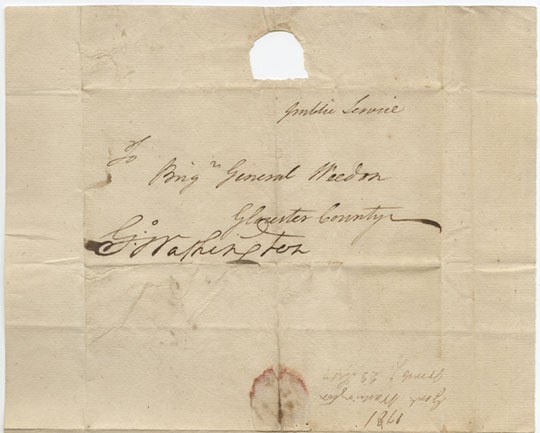
Mann Page. American patriot from a powerful Virginia family; member of the Continental Congress. Wartime ALS, 1p, folio, Baltimore, March 5th, 1777. With original leaf addressed to Brigadier General George Weedon, bearing his extremely rare franking signature and a straight line postmark, “Baltimore, March 15”. Also docketed by Weedon in his hand.

Important letter on politics, his lack of transportation and health problems:

“Baltimore March 5 1777

Dear Sir, I wrote to you by Coll Spotswood but by accident my letter did not fall in his Way. I now enclose it to you to let you see I had not forgot you. We have nothing worth telling you of in this place except that Congress has been so mad as to return to Philadelphia. I am left prettily in the lurch, expecting that we were fixed at this place, I sent back our Chariot & now do not know how to move my baggage. Wives are sometimes sad encumbrances. I have not heard for some time from Virginia, but hope all are well. Why need you think the Lustre of the Virga Army is tarnished by Buckner’s misconduct? True, he is a Virginian, but compare other Virginians with him & they will appear in brighter colors. It is by comparison only that we judge of Men & Actions, therefore a few bad men or actions make good men & actions show more conspicuously. I am still in the Small Pox, therefore cannot write more than that I am, Your affectionate friend, Mann Page Jun.”

Address leaf---“Brigadier General George Weedon, Free, Mann Page Jun.” Docketed—“M.Mann Page Jun, 1777”.

$2,800

FOUR PAGE HANDWRITTEN LETTER FROM JOHN RUTLEDGE TO HENRY LAURENS CONGRATULATING HIM ON HIS ELECTION TO THE PRESIDENCY OF THE CONTINENTAL CONGRESS IN 1777
John Rutledge (USA, 1739 - 1800)

Autograph Letter Signed, 4pp, 4to, Charlestown {S.C.}, Nov.29th, 1777. To Henry Laurens.

John Rutledge (1739-1800). Statesman, jurist, brother of Signer Edward Rutledge; President of the South Carolina General Assembly. Rare ALS to Henry Laurens congratulating him on his becoming President of the Continental Congress and other matters:

Chas.Town Nov.29th, 1777 Dr Sir, I recd. Your favor of Octr 26th last Wednesday Evening- It cd not have arrived at a more unlucky time as the Judge of the Admiralty, & Attorney General, were on the Circuit, & ther Register out of Town, so that, I cd not possibly obtain obtain any information on Arthur’s Case.- I determined however, to detain the Express in Expectation that on Transes return, I might know what I wanted, but I could not.- I have indeed seen the Pleadings in the Cause, but the Minutes of the Court’s proceedings were lent by the Register to Mr.Reid, who is also on the Circuit- so that I cannot as yet know why the appeal was not admitted, or, what are the contents of Mr.Moultries Letter, which you mention.- & altho’ it is impossible for the Bearer to reach you, within the Time allowed by the Bench of Appeals, yet, that there may be no lacking on my part, I think it proper to send him off, to apprize you of the Circumstances abovementd.- I shall detain Zimmoman until the Return, from the Circuit, of the Gen --- Abovementioned , when I shall see the Attorney General & you shall hear from him, & on the Subject. I thank you for the copy of Mr.Dudlio’s letter & really know not which to be most amazed art, his Villainy, or his Independence.- I think however, it was a pitiful Shift of General Howe’s---How little does he yet know of America! Without Doubt, your Friends Letters accompanying this [not present] give you the Intelligence of an Embargo at Cape Tancers and Martinique, the American Vessels being ordered from the Cape, & any other News we have- I will therefore, only add, that Indian Affairs both as to Creeks & Cherokees, wear a favorable Aspect, & if we can keep ‘em supplied with Goods, I think they will continue peaceable- I am anxious to hear the Determination of Congress relating to the Southern Indian Trade---The Little Carpenter & Great Warrior are on their Way down, from Sondea, being very desirous to come to this Town. A Sloop is just arriving here, bound from Grenada to New York with 70 Puncheons of Rum & 6 Hogsheads of Sugar, for the King’s Troops here—The Mate & Crew rose on the Captn, & brought her in here, so that, The Resolve of Congress, declaring Vessels & Cargoes, in such Circumstances, Prize, came opportunity. Give me Leave to congratulate you on being elected President of Congress---I know the Office will involve you in a Multiplicity of Business & and great Fatigue, but, you are a Man of Business, & will disregard Fatigue, when, the Enduring it assists our Cause---The Choice affords me much Pleasure, because without Compliment, I am certain Congress have not a Member so fit for the Chair, & they have, in this Instance, not only shewn themselves sensible of Merit, but paid it due Honour—I should indeed lament your not being on the Floor, when Questions of Important are in Debate, did I not presume, that such will always be first considered, in a Committee of the whole House. I am with great Esteem & Respect Sir, Yr. obed. Hble Servt J.Rutledge The Honble Henry Laurens, Esq. Docketed in Laurens’ hand: “Presdt Rutledge/ 29 Novbr 1777/ Rec’d 21 Decem"

$8,500

WILLIAM WHIPPLE ADVISES ROBERT MORRIS THAT THE SHIP AMPHITRITE IS READY TO SAIL FOR FRANCE
William Whipple (USA, 1730 - 1785)

WILLIAM WHIPPLE. Signer of the Declaration from New Hampshire. Autograph Letter (either a draft or retained copy), ½ page, 4to, no date but from the docket, early July, 1777. To Robert Morris.

Whipple advise Morris that the French ship Amphitrite is ready to sail. The letter reads, “The Amphitrite will sail this week agreeable to orders. The Captain did not make the least difficulty after receiving the Letter I brought from the Committee but immediately set about preparing his ship for her voyage. Thus, Sir, have I given you an audt. Of Navy matters in this Quarter…” Docketed, “To Robt Morris, Esq 6 July (1777)”.

The Amphitrite Had been sent from France in December of 1776 laden with 15,000 uniforms, 10,000 muskets, and about 75 bronze cannons, all funded by the flamboyant playwright, Beaumarchais. These supplies were undoubtedly used at Saratoga and were most instrumental in the American victory.

On the Amphitrite’s return to France in 1777 she initially was to be commanded by Captain Roche. He was to be accompanied by John Paul Jones who by an act of Congress was to assume command of the first ship he could, in France. The Amphitrite was armed and authorized to capture any prizes it could along the way.

This letter was also part of the Langdon Papers deaccessioned from the Portsmouth Historical Society in the early 1990’s. Like the Richard Henry Lee letter in this section, it was sold privately before the auction and has never appeared on the market.

$1,750