
|
|
|
|
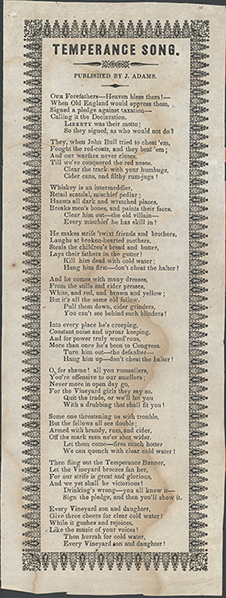 An Early Temperance Broadside Poem An Early Temperance Broadside Poem
John Adams (USA, 1810 - 1820)Broadside on paper, 11 3/4 x 4 inches, entitled, "Temperance Song", being a poem about the evils of drink.
Ten stanza poem printed in Delaware by J. Adams circa 1810-1820. It reads in part:
"Whiskey is an intermeddler,
Retail scandal, mischief peddlar;
Haunts all dark and wretched places,
Breaks men's bones, and paints their faces,
Clear him out-the old villain-
Every mischief he has skill in!"
$120 |
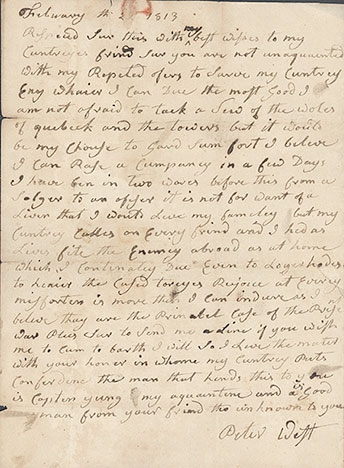 | War Dated Letter From an Old Soldier Trying to Re-enlist
[War of 1812] (USA, 1812 - 1815)Peter West; soldier. ALS, 1p, 4to, n.p., February the 22nd, 1813. To "The Honarabel)sic) Joseph King at Barth".
Patriotic letter from an uneducated man who had served in several wars, trying to enlist in a War of 1812 company:" Respected Sur, this with my best wishes to my countries frind sur you are not unaquainted with my Repeted ofers to surve my country eny whaies I can due the most good. I am not afraid to tack a few of the water of quibeck and the towers but it would be my chouse to gard sum fort. I beleve I can rase a company in a few days. I have been in two wares before this from a solger to an ofiser. It is not for want of a Livin that I would leve my famileybut my Countrey Calles on every frind. And I has as liven fite the Enemy abroad as at home which I continaly due. Even to Logerhades to hearin the Cused Toreyes Rejioce at every misforten is more thn I can indure. I belive they are the Prinable Case of the Present War. Plees Sur to send me a line if you wish me to cum to Barth I will. So I leve the mater with your honer in whome my country puts Confurdenc. The man that hands this to you is Captain Young, my aquaintenc and is a good man, from your frind tho un nown to you, Peter West".
Contemporary War of 1812 military letters are extremely scarce.
$1,500 |
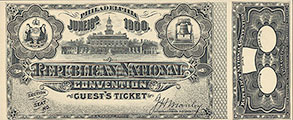 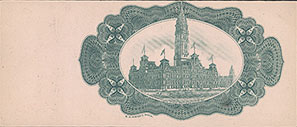 | Unused Ticket to the Republican Convention of 1900
[1900 Republican Convention Ticket] (USA, 1900)An unused first day mint condition ticket including the stub to the Republican Convention in Philadelphia, June 19, 1900, . Printed by E.A.Wright, Philadelphia, with his imprint on the reverse. Independence Hall, the seal of Philadelphia, and the Liberty Bell are engraved on the front, with an elaborate green engraving of City Hall on the reverse of the main ticket.
Held from June 19th to June 21st, the Convention unanimously nominated William McKinley for President, and Theodore Roosevelt for Vice-President replacing the previous Vice-President, Garret Hobart, who had died in 1899. McKinley easily won the presidency but was assassinated in 1901 launching Roosevelt into the presidency.
$175 |
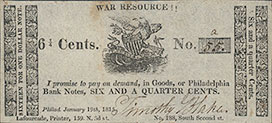 | Rare 6 1/4 ¢ Banknote Issued in Philadelphia Near the End of the War of 1812
Timothy Blake (USA, 1815)
Timothy Blake (USA, 1815)A small demand note for six and a quarter cents, printed on one side by the Philadelphia printer, Lafourcade, signed by Timothy Blake, and dated January 19th, 1815.Bold eagle and shield at top center with the words "WAR RESOURCE!!" above the engraving. Extremely rare;numbered 55. Hoober 305-716.
$850 |
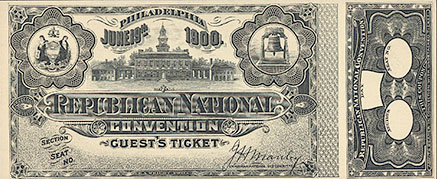 | Unused Guest's Ticket to the Republican National Convention of 1900
Republican National Convention (USA, 1900)An unused first day mint condition ticket including the stub to the Republican National Convention in Philadelphia, June 19, 1900, . Printed by E.A.Wright, Philadelphia, with his imprint on the reverse. Independence Hall, the seal of Philadelphia, and the Liberty Bell are engraved on the front, with an elaborate green engraving of City Hall on the reverse of the main ticket.
Held from June 19th to June 21st, the Convention unanimously nominated William McKinley for President, and Theodore Roosevelt for Vice-President replacing the previous Vice-President, Garret Hobart, who had died in 1899. McKinley easily won the presidency but was assassinated in 1901 launching Roosevelt into the presidency.
$175 |
|
|
|
