P. O. Box 440
Garrison, NY 10524
P: (845) 424-4689
F: E: bgimelson@aol.com
 

Paintings
Browse by Name: 
OIL STUDY OF MOLLY PITCHER AT THE BATTLE OF MONMOUTH BY DENNIS MALONE CARTER
Dennis Malone Carter (USA, 1827 - 1881)

Oil on canvas; 7½ x 7 ⅓ inches. Signed LL, “D.M.Carter”, titled on verso in the artist’s hand "Moll Pitcher at Monmouth 1854”. The final finished painting of this subject is in the Fraunces Tavern Museum Collection. In addition there have been numerous prints stylized or directly from the Carter painting. Matted and framed.

The Battle of Monmouth took place in New Jersey, 28th June 1778. There were 10,000 British troops led by Lt.General Sir Henry Clinton and Major General Earl Cornwallis against 11,000 Americans in turn led by Generals George Washington and Charles Lee. Historians have taken it as a draw although Lee’s troops made a less than heroic retreat.

A wife of an artilleryman named Mary Hays McCauly (better known as Molly Pitcher) had spent the winter at Valley Forge with her husband. At the Battle of Monmouth she set about with a pitcher of water quenching the thirst of the American soldiers. She also tended to the wounded and at one point manned the cannon of her fallen husband. For her efforts she was accorded a warrant by Washington as a noncommissioned officer; a monument on the battlefield commemorates her heroic deeds.

$8,500

JEWISH ARTIST FREDERICK ELMOUR COHEN ILLUSTRATES A LETTER WITH TWO SELF PORTRAITS
Frederick Elmour Cohen (British/American - 1858)

Portrait, miniature, historical, and genre painter. An English Jew, he immigrated to Detroit from Canada, during the rebellion of 1837, where he stayed until 1855.

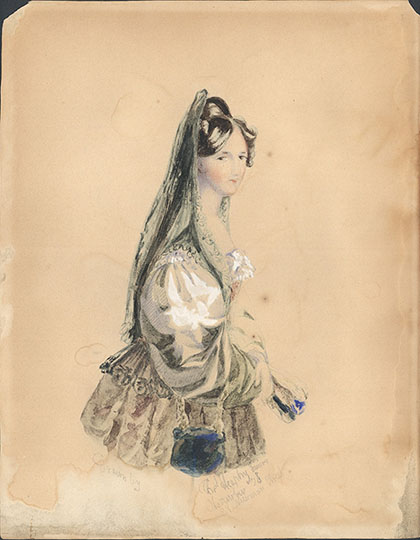
Cohen, in a 2 page letter to a friend, “Mrs.Capt.Montieth / Canandaigua, NY”, dated at Detroit, October 22, 1846, paints a brilliant watercolor portrait of himself and his wife on the blank leaf. In addition he has drawn a pen and ink self-portrait at the bottom of the second page.

In the letter Cohen writes about his brother and that his sister “ would certainly enjoy the society of my wife & her friends, for she is a person who is and ever has been strictly pious, and so are all her conexions (sic) in this city, of the highest respectability and everything I know would suit her…” In a later part of the letter he explains his ink portrait and discusses some other of his own life portraits while critiquing the attached painting: “…I send you a miniature of Myself & Wife. They are considered very good likenesses. My wife is taken from the original herself, and is as near as I could come to a perfect miniature. My own is taken from one in my studio as large as life which is often taken & spoken to as though it was the original. However, sufise (sic) it to say that any person you show this picture to will know both of us where ever they may meet us, if they have any kind of memory. That gown I wear is my working gown. I have a large hat to match it, but it gives me to wild a look to paint it so I have left that off although there are 3 portraits of me in Buffalo, one in Chicago & 2 in New York that have all got the hat on- they look like this [On the lower left hand corner of page two Cohen has drawn a picture of himself with a hat and the caption- I am a handsome child ain’t I; poor boy, it is a great pity. I didn’t use’d to be always so too]….”

Another Cohen self portrait is in the Detroit Museum of Fine Arts. An extraordinary illustrated letter by an important artist, which encompasses the areas of American, English, and Canadian Judaica, Art, and Michiganiana.

Housed in a quarter calf fitted box with a removable framed matte through which the painting may be viewed.

$8,500

IVORY MINIATURE OF CHESTER LOSSING WHEN HE WAS 16 OR 17 YEARS OLD
William M.S. Doyle (USA, 1769 - 1828)

Watercolor on ivory; 2 11/16 x 2 ¼ inches. Old metal frame.

Inscribed on back by a child: “This likeness of dear father Mr.Chester Lossing. Papa was quite young 16 or 17 years old I’ve heard him say. E.R.L.” Around back edge, “ It was taken by Doyle who kept the Columbian Museum Boston/MS”

The Columbian Museum exhibited natural history specimens, wax figures, and art. It had been previously owned and run by Edward Savage and Daniel Bowen in New York City; Doyle became Bowen’s partner. This miniature was purchased with several others from descendants of General Anthony Lamb.

$3,500

THE LOST MINIATURE OF PATRICK HENRY
M. Emmet (USA, 1736 - 1799)

Miniature watercolor on ivory; 3 3/8 x 2 7/16 inches. Signed diagonally, "M.Emmet", right center. Early 19th century; excellent condition.

Included is an engraving, circa 1835, identical to the miniature with the following legend below the portrait: "Engraved by E.Wellmore from a Painting by J.B.Longacre after an Original Miniature in the possession of John S.Fleming of Virginia". Some foxing on the engraving.

An extraordinarily fine example of what appears to be the lost miniature of Patrick Henry, an extremely rare subject in any form. According to the legend on the print, James Barton Longacre (1794-1869) created a painting after this very miniature.

Patrick Henry, one of the firebrands of the American Revolution, urged military preparedness. He is best known for his speech to the Virginia House of Burgesses in Saint John's Church, March 23, 1777 in which he uttered the immortal words, "Is life so dear, or peace so sweet, as to be purchased at the price of chains and slavery? Forbid it, Almighty God! I know not what course others may take; but as for me, give me liberty or give me death!"

Sold

MINIATURE PAINTING OF DANIEL BOONE
Chester Harding, after

Watercolor on ivory; 3 ½ x 2 /3/4 inches Signed “n. (after) Harding” In a custom brass frame.

Chester Harding, who had already made a name for himself painting the likenesses of famous politicians and prominent citizens, removed himself to St. Louis in early 1820. In June of that year he set out on a quest to find the 86-year-old Daniel Boone in order to paint the most famous frontiersman in America. After a hundred mile trek through uninhabited territory he located him in a small cabin in the Femme Osage Valley in St. Charles County, Missouri. Harding recounted that he found Boone stretched out on a bed, roasting some meat attached to a ramrod. He spent several hours trying to explain to Boone what he wanted to do, and lived with him for a week taking sketches and one small oil from which he made copies. Harding was probably the only artist to paint Daniel Boone from life.

Many legends surround the great frontiersman Daniel Boone, and unlike those of several others, most of these stories were true. Much of what the average American knows about Boone was what they saw depicted, sometimes correctly, by Buddy Ebson on the 1950’s TV series. Boone liked to hunt for food using only a knife and actually killed several bears in this manner. He fought with Braddock in 1755, founded the town of Boonesborough, was captured by Shawnees in 1778 and partially scalped (he always wore a cap or white wig), and became a surveyor. He also fought the government for many years to get back land, which had been confiscated. Sold

Exceptional Genre Scene of Three Black Children in a Decrepit Wagon at the End of the Day
Edward Lamson Henry (USA, 1841 - 1913)

PLAYED OUT

Signed E.L.Henry and dated ’86, l.r. Oil on canvas 13 ½ x 19 inches (34.3 by 48.3cm.)

Sold

POR

EARLY TWENTIETH CENTURY INDUSTRIAL PORTRAIT OF WORKERS ROLLING MOLTEN STEEL
Arthur Kampf (Germany, 1864 - 1950)

Oil on canvas, 19 x 31 inches, signed “A.Kampf”, lower right. In what appears to be the original frame, circa 1910.

Oil on canvas, 19 x 31 inches, signed “A.Kampf”, lower right. In what appears to be the original frame, circa 1910.

An early example of the artist’s work showing workmen rolling molten metal in a steel mill. With an old Jordan Volpe Gallery tag.

$16,500

Return from Market
John Lewis Krimmel (USA, 1787 - 1821)

Oil on panel; 8 1/4 x 11 inches.Accomplished between 1815 and 1820.

The reverse of the panel includes a sketch of a tree, an illegible inscription to a "Miss Susan ___; The number "14717" is at the upper right corner.

A genre setting of a family returning from market with purchased wares as the black servant holds the horse attached to a wagon. This is a study for the final painting which has been lost. Engraved twice, once by Alexander Lawson, and another time by John Sartain.

Illustrated in Kennedy Galleries Kennedy Quarterly, January 1977, page 100, description of the painting and artist, page 123; listed as "No.56" in Milo M.Naeve's book, John Lewis Krimmel.

Exhibited:1822 (Philadelphia) Eleventh Annual Exhibition of the Pennsylvania Academy of Fine Arts No.406, titled The Return from Market and described as a "sketch in oil".

$28,000

SEASCAPE BY EDWARD MORAN
Edward Moran (USA, 1829 - 1901)

Oil on canvas; 9 1/2 x 11 3/4 inches, signed lower right; old period frame

Edward Moran was the older brother of the great Hudson River and western artist, Thomas Moran. He was best known for his marine and shore paintings and exhibited frequently at the Pennsylvania Academy of Fine Arts (PAFA) and the National Academy of Design (NAD) among many others.

$6,500

Still Life with Book, Pipe, Matches, and Mug
John Frederick Peto (USA, 1854 - 1907)

Oil on artist's board; 6 x 9 inches. Signed UL, J.F.Peto '89

Purchased from Kennedy Galleries in 1970 with original label

POR

Still Life with Roses, Bowl, and Oriental Urn
Milne Ramsey (USA, 1847 - 1915)

Oil on canvas; 23 x 36 inches. Signed LR and dated "87". Period frame.

$46,000

Portrait of Robert Morris After Charles Willson Peale
American School (USA, 1782 - 1798)

Graphite and watercolor on paper, 5 x 3¾ inches, in original frame with reverse painted glass mat, unsigned. Taken from the Charles Willson Peale portrait of 1782, currently in the Pennsylvania Academy of Fine Arts collection.

The image is inscribed on the verso, "Robt.Morris" in a contemporary 18th century hand and is mounted on a folded, handwritten addendum to a will dated 1798. On the back of the frame is the label "Charles N.Robinson Carver and Gilder No.86 Chestnut Street, Philadelphia"

Robert Morris (1734-1806) was a Signer of the Declaration. With Haym Salomon, he was most instrumental in financing the American Revolution. In 1781 he established the Bank of North America which served to somewhat stabilize the rocky American economy. Because of failed land speculation in the late 1790's, Morris, who was the largest private landholder in America went bankrupt and served four years in debtor's prison, the only Signer to suffer that fate.

$9,500

Design for World’s Fair, 1939
Charles Sheeler (USA, 1883 - 1965)

Conde crayon on paper; signed and dated 1939, lower center, 9 x 7 inches. According to Martin Friedman, Sheeler was at the peak of his Relative Realism. With label of New York gallery.

POR

PORTRAIT OF JOHN JACOB ASTOR
Gilbert Stuart (USA, 1755 - 1828)

Portrait, ca 1794. Oil on canvas laid down on board. 36 x 29 inches (91.4 x 73.6cm)

Provenance: Mrs. Walter Astor Langdon, daughter of the sitter Mrs. Emily Astor Kane Jay By descent in the Astor family to the present owner

John Jacob Astor is among the most important financiers and entrepreneurs in American history- He was the first American millionaire. Born in Waldorf, Germany in 1763, Astor arrived in New York in 1784, opened a small shop and by the late 1780’s was actively trading furs. By 1800 when he had amassed a fortune of over a quarter of a million dollars, he was the acknowledged leader in the American fur trade. Around this time Astor began to trade actively in the Far East and to acquire large tracts of Manhattan real estate, which would become the bulk of the family fortune. By 1834 Astor sold all of his interests in the fur trade and focused his investments on New York real estate. When Astor died in 1848 his net worth was estimated conservatively at $20,000,000. All of his fortune - except $2,000,000 in various bequests and $400,000 to found a library that would become part of the New York Public Library – passed to his son, William Blackhouse Astor. In his day, Washington Irving lauded Astor for his benevolence and public spirit; whereas others were less complementary, and when Astor died in 1848 the New York Times wrote, “ He has exhibited at best but the ingenious powers of a self-invented money-making machine.”

Astor sat for Gilbert Stuart, the most important portrait painter in America, around 1794, a time when Astor’s fortune was growing at an extraordinary pace. Stuart executed two portraits of Astor; the sitter rejected the first, a bust length canvas now in the collection of The Brook, New York. Stuart subsequently executed a second example, a half-length portrait, which portrays the sitter as more handsome and youthful than the first version. The second work, recorded in Lawrence Park’s monograph on Stuart, descended through the English branch of the Astor family.

Accompanied by Dr.Richard McLanathan’s (expert on Gilbert Stuart and author of “Gilbert Stuart – Father of American Portraiture”) “Letter of Authenticity” and research, stating that the great American portraitist Gilbert Stuart accomplished this painting. Also included is an additional document authenticating this painting prepared by the late David Meschutt, the leading expert in American portraiture until his untimely death in 2005.

POR

WATERCOLOR PORTRAIT OF JOHN ADAMS AFTER GILBERT STUART
Gilbert Stuart, after (USA, 1755 - 1828)

Possibly by James Barton Longacre (1794-1869) for an engraving

John Adams at 89

Watercolor on paper, 6 1/2 x 4 1/2 inches

In the fall of 1823, after repeated requests from then Secretary of State John Quincy Adams, Gilbert Stuart made his way to Quincy, Massachusetts to begin his final portrait of John Adams. Twenty-five years had passed since Stuart had painted his Presidential portrait and John Quincy Adams wished “ to possess a likeness of him as he now is…”. The portrait was completed on John Adams’ eighty-ninth birthday, October 30, 1824.

This watercolor is identical in all ways to the original oil painting and is the only one of its kind. Stuart did paint a copy of the 1823 John Adams portrait in 1826, and Charles Bird King accomplished a lesser copy in oils in 1827. John Cranch, Jane Stuart, George Healy, and Henry Inman did later copies of the original. A poor engraving after the Stuart oil portrait, showing a scowling John Adams, was made by Thomas Gimbrede in 1831. None of the copies are as finely and faithfully painted as this watercolor.

Literature:

Andrew Oliver, Portraits of John and Abigail Adams, Belknap Press, 1967; pp 188-201 Richard McLanathan, Gilbert Stuart, Harry Abrams, 1996, pp 147-149 Charles Merrill Mount, Gilbert Stuart, a Biography, W.W.Norton, 1964;pp 320-322; 363 Lawrence Park, Gilbert Stuart, an Illustrated Descriptive List of His Work, 4 vols, New York, 1926, No.6 National Gallery of Art, Gilbert Stuart, Portraitist of the Young Republic, Providence, 1967; pp 108-109

SOLD

AN IMPORTANT ABBOTT THAYER DISCOVERY: AN ORIGINAL PRESENTATION WATERCOLOR AND PENCIL STUDY FOR HIS BOWDOIN COLLEGE MURAL MASTERPIECE, FLORENCE PROTECTING THE ARTS
Abbott Handerson Thayer (USA, 1849 - 1921)

Abbott Handerson Thayer (American, 1849-1921)

Much has been written about this great artist from his protective coloration techniques, which lead up to the invention of camouflage, to his untimely end fighting depression and a stroke. But of all he accomplished there could have been much more for as we know from his 1893 Walker Art Gallery commission at Bowdoin College he was also a brilliant muralist. Unfortunately, the Bowdoin masterpiece was his only mural.

Offered is a watercolor and pencil study for this most important work, Florence Protecting the Arts, which to this day is still installed at the Walker Art Gallery, Bowdoin College, Brunswick, Maine. The study on brown paper measures 6 5/8 x 10 ¾ inches and is contained in double-glazed early 20th century frame. On the reverse are three watercolor studies for stylized Maltese crosses, probably intended for inclusion on the bottom of the finished painting, although not used exactly. It is signed by the artist, lower right, “A.H.T”, and has an additional presentation inscription (possibly in another hand), “Sketch for Bowdoin College by Abbott H.Thayer – Presented to Honny O’Connor by AHT 1920”. Also included and illustrated here is a matching framed contemporary photograph of the installation.

Commissioned by the Walker Art Gallery architects McKim, Mead, and White work was begun in Dublin in 1893 on this monumental project. We know from Thayer’s journals that Elise Pumpelly, the daughter of a neighbor was utilized as the model for the central figure (“Florence”). Many art historians believe that this central figure spawned the genesis of another masterpiece, and perhaps his best-known painting, Caritas. Thayer developed the work to include five figures- two children at the side of the main figure with two kneeling figures of a man and woman flanking the composition. The two kneeling outside figures according to his journals were a Thayer family woman servant “Polla” to the right, and the family handyman Edward Meehan to the left.

Bibliography: Abbott H.Thayer, Painter and Naturalist by Nelson C. White, 1951.

POR

Bright Painting of a Fishing Trawler in a Choppy Sea
James Gale Tyler (USA, 1855 - 1931)

James Gale Tyler. Oil on board, 10 and one-half by 18 inches.

Tyler was known both for his nocturnal paintings and those of the America's Cup Race that he did every year from 1901 until 1930. In this picture he depicts a colorful bright trawler steaming for home pulling two whaleboats ,about to pass a buoy. In the distance are other ships. He shows a real competence as a marine painter.Original period frame.

$14,500

Whimsical Space Cartoon Illustration by Dudley Ward
William Dudley B. Ward (Canada, 1879 - 1935)

Watercolor and gouache on board; 15½ x 12¼ inches. Signed "Dudley Ward / 33", lower right. Shows group of aliens surrounding an intricate type of giant ray machine complete with lense, reflector and gears, with one strapped to it.

$3,500

VIBRANT MINIATURE PAINTING OF CHARLES PENDLETON GORDON FROM NORTH CAROLINA
Carl Weinedel, attrib. (USA, 1795 - 1843)

Charles Pendleton Gordon (b.Wilkes Co, N.C.1791; d.Eaton, Georgia, 1836)

Watercolor on ivory; oval, 3 ½ x 3 inches Original frame and oval insert.

On back of frame is written, “This is Charles Pendleton Gordon Father of Sarah Gordon Wilkins Who was mother of Josie Wilkins Woolfolk Mother of William Gordon Woolfolk 1877-1854” Sold

The Susquehanna
Thomas Worthington Whittredge (USA, 1820 - 1910)

Oil on paper mounted on board; 10 x 12 inches. Signed, “W Whittredge,” lower right. Old frame with titled label.

The Susquehanna River is 444 miles long. It rises in Ostego Lake, in central New York, and flows across Pennsylvania and parts of Maryland. Whittredge, a giant among 19th-century American artists, has captured the smooth essence of the river’s source, melding many shades of green and blue.

Exhibited: Visions of the Susquehanna, Lancaster Museum of Art and travelling, 2006-2008

Literature: Visions of the Susquehanna, 250 Years of Paintings by American Masters,Rob Evans, Lancaster Museum of Art, Lancaster, PA, 2006; page 31, plate 10.

$28,000